Arabic letters and long vowels are the focus of this lesson. In previous lesson, you learned the Arabic letters and their pronunciation which varies according to the short vowel that accompanies them. For example, we pronounce the letter ل as لَ la, لِ li, or لُ lu. What if a long vowel follows the Arabic letters, to what degree their pronunciation differs.
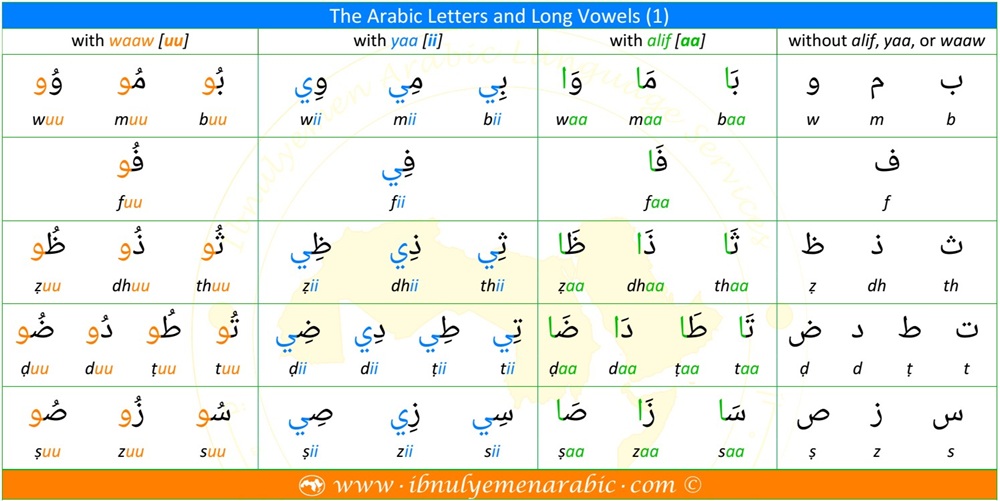
![This table shows the long vowels in Arabic. They are alif [aa], yaa [ii], and waaw [uu], prolonged versions of short vowels.](https://www.ibnulyemenarabic.com/wp-content/uploads/2018/10/long-vowels-in-arabic-1.jpg)
What are the Arabic long vowels? There are three long vowels in Arabic, and we call them in Arabic al-ḥarakaat uṭ-ṭawiirah (الْحَرَكَاتُ الطَّوِيلَة). Unlike short vowels, they are letters, and they are the alif (ا), the yaa (ي), and the waaw (و). The pronunciation of the alif is aa, as in سَامَحَ (saamaḥ), قَاوَمَ (qaawama), and شَاغَبَ (shaaghaba) in the first column in the table above. As for the yaa, we pronounce it ii, as in حَزِين (ḥaziin), عَلِيم (ʿaliim), and سَمِيك (samiik) in the second column. And the waaw is pronounced uu, as in فُول (fuul), ثُوم (thuum), and حُوت (ḥuut) in the third column. Therefore, the long vowels in Arabic are prolonged versions of the short vowels. That is, aa corresponds to a; ii corresponds to i; and uu corresponds to u.
Observe that long vowels in Arabic are not assigned short vowels. In other words, they are always saakina (سَاكِنَة). For this reason, it would be redundant to add the sukuun (سُكُون) over them. The alif is always saakin (سَاكِن) regardless of its position in the word. The yaa and waaw, however, can be accompanied by short vowels. In this case, they become consonant-like. Take the word قَاوَمَ qaawama in the first column. The waaw here is accompanied by fatḥa, hence consonant-like. More importantly, long vowels in Arabic always trigger the corresponding short vowel over the letter that precedes them in word strings. In the table above, for example, the waaw in fuul triggers the ḍamma over the f, hence فُول. Likewise, the alif in qaawama triggers the fatḥa over the q, hence قَاوَمَ. By the same token, the yaa in samiik triggers the kasra under the m, hence سَمِيك.
Additionally, keep in mind that there are cases in which the sukuun is added over the yaa and waaw. They, as a result, become diphthongs (i.e., a combination of two vowels). In such instances, the letter before them is accompanied by the fatḥa (a). Good examples of these are بَيْت (bayt or bait) ‘a house’, سَيْف (sayf or saif) ‘a sword’, فَوْق (fawq or fouq) ‘on/over’, and مَوْت (mawt or mout) ‘death’.
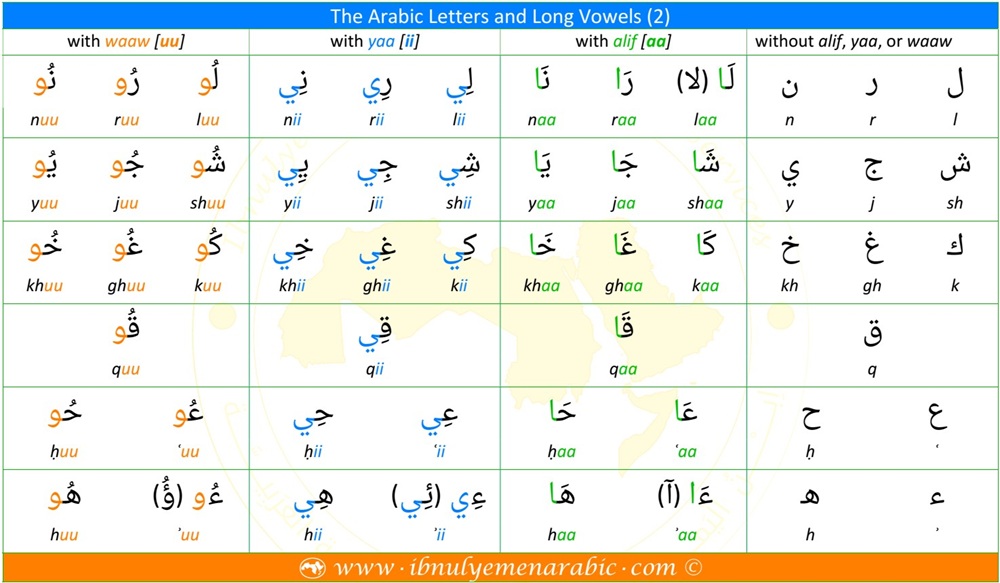
If the long vowels follow the Arabic letters, their pronunciation remain relatively similar. The difference is in the lengthening of the short vowel. For example, the pronunciation of ب with fatḥa (بَ) is ba. If the long vowel (ا) follows the ب, (i.e., بَا), its pronunciation becomes baa. Likewise, بِ bi becomes بِي bii, and بُ bu becomes بُو buu. And so is the case with the remaining letters, that is maa, mii, muu; faa, fii, fuu; waa, wii, wuu etc., as in tables (1) above and (2) below.
As you can see in the tables, and noted earlier, the long vowel always triggers the appearance of the corresponding short vowel on the preceding letter, hence the alif triggers the fatḥa, as in سَا, بَا, and مَا; the yaa’ triggers the kasra, as in سِي, بِي, and مِي; and the waaw triggers the ḍamma, as in سُو, بُو, and مُو.
In the last row of table (2) the hamza (هَمْزَة) (also spelled hamzah) ء is written as madda (مَدَّة) (also spelled maddah) آ when it is accompanied by fatḥa and followed by alif ـا. So, the maddah is a combination of hamzah and alif (ءَ+ا = آ), and it is pronounced aa (personally, I think it a bit long than the long vowel alif, so I would say aaa is more accurate, though it might sound too much for some). If accompanied by kasra and followed by yaa, we write it on a nebra (نَبْرَة), that is ئي / ـئي. When it is accompanied by ḍamma and followed by waaw و, we write it ـؤ / ؤ. You can learn more about the hamza here.
In the next lesson, you will get to know how to join these letters cursively to form Arabic words.