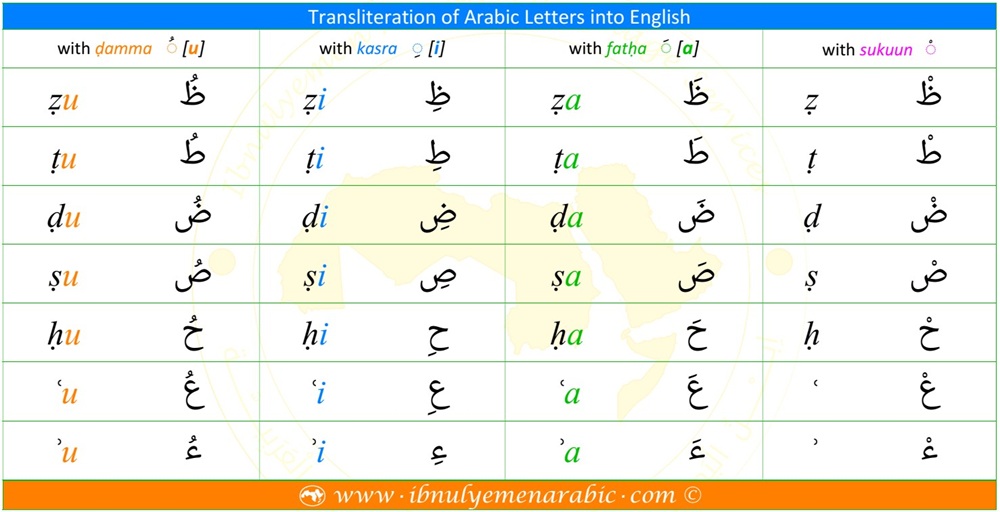
Transliteration of Arabic letters into English is not recommended for a learner of Arabic as foreign language. However, in the early stages of learning, using transliteration is inevitable and sometime useful for most learners. It facilitates transition from the pure beginner stage to the upper-beginner stage. Plus, it speeds up the learning process. Despite this, the learner, especially whose native language is English, still encounter problems with certain letters because Arabic and English belong to different language families. As a semitic language, Arabic has a set of letters that do not exist in English. These are: ظ، ط، ض، ص، غ، خ، ق، ع، ح، ء. Therefore, we need special symbols to transliterate these letters, as you can see in the table above. As for the غ, خ, and ق, they are transliterated as kh, gh and q, respectively.
In the list below, you can see how the Arabic letters are transliterated into English. The possible pronunciations of each letters are listed, that is with sukuun (سُكُون), with fatḥa (فَتْحَة), with kasra (كَسْرَة), and with ḍamma (ضَمَّة).
Transliteration of Arabic Letters into English | |||||||
| l | لْ | ṭ | طْ | dh | ذْ | b | بْ |
| la | لَ | ṭa | طَ | dha | ذَ | ba | بَ |
| li | لِ | ṭi | طِ | dhi | ذِ | bi | بِ |
| lu | لُ | ṭu | طُ | dhu | ذُ | bu | بُ |
| m | مْ | ẓ | ظْ | r | رْ | t | تْ |
| ma | مَ | ẓa | ظَ | ra | رَ | ta | تَ |
| mi | مِ | ẓi | ظِ | ri | رِ | ti | تِ |
| mu | مُ | ẓu | ظُ | ru | رُ | tu | تُ |
| n | نْ | ʿ | عْ | z | زْ | th | ثْ |
| na | نَ | ʿa | عَ | za | زَ | tha | ثَ |
| ni | نِ | ʿi | عِ | zi | زِ | thi | ثِ |
| nu | نُ | ʿu | عُ | zu | زُ | thu | ثُ |
| h | هْـ | gh | غْ | s | سْ | j | جْ |
| ha | هَـ | gha | غَ | sa | سَ | ja | جَ |
| hi | هِـ | ghi | غِ | si | سِ | ji | جِ |
| hu | هُـ | ghu | غُ | su | سُ | ju | جُ |
| w | وْ | f | فْ | sh | شْ | ḥ | حْ |
| wa | وَ | fa | فَ | sha | شَ | ḥa | حَ |
| wi | وِ | fi | فِ | shi | شِ | ḥi | حِ |
| wu | وُ | fu | فُ | shu | شُ | ḥu | حُ |
| y | يْ | q | قْ | ṣ | صْ | kh | خْ |
| ya | يَ | qa | قَ | ṣa | صَ | kha | خَ |
| yi | يِ | qi | قِ | ṣi | صِ | khi | خِ |
| yu | يُ | qu | قُ | ṣu | صُ | khu | خُ |
| ʾ | ءْ | k | كْ | ḍ | ضْ | d | دْ |
| ʾa | ءَ، أَ | ka | كَ | ḍa | ضَ | da | دَ |
| ʾi | ـئِـ ، ءِ، إِ | ki | كِ | ḍi | ضِ | di | دِ |
| ʾu | ـؤُ | ku | كُ | ḍu | ضُ | du | دُ |
In the next lesson, you will learn about the diacritics in Arabic, namely the short vowels and why they are not written in Modern Standard Arabic.