There are twenty-eight letters in the Arabic Alphabet. These Arabic letters are consonants. Two of them are also vowels; that is, besides being consonants, they are also vowels. In addition to these, there are the alif without hamza (هَمْزَة) (also spelled hamzah) (ا) and the madda (مَدَّة) (also spelled maddah) (آ). The maddah is a combination of alif with hamza (أ) and alif without hamza (ا) or a hamzah (ء) and alif, that is أ+ا = آ and ء+ا = آ. A good example of it is the word آدَم "Adam" and قُرْآن "Quran".
So, how many letters are there in the Arabic alphabet? There are thirty Arabic letters in total. As regards vowels, there are six vowels in Arabic: three short vowels and three long vowels. The short vowels are secondary since we don't add them in Modern Standard Arabic (MSA). On the other hand, the long vowels are primary, for they are orthographically like other consonant letters.
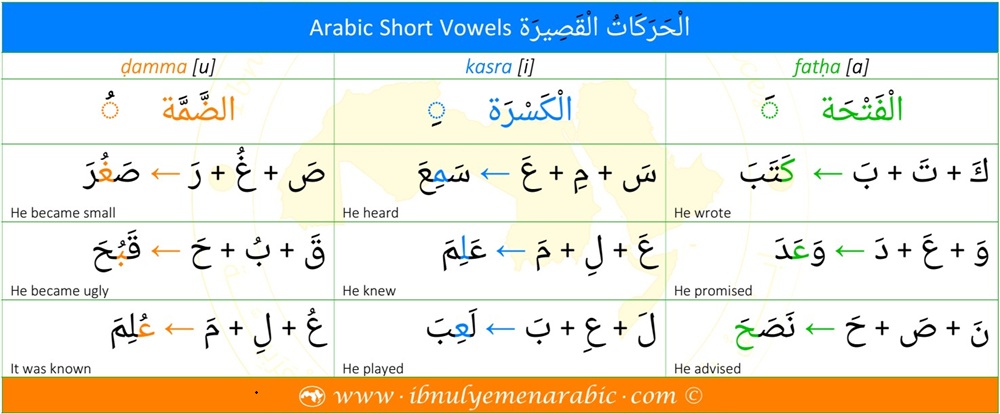
What are the short vowels in Arabic? The short vowels in Arabic are called al-ḥarakaat ul-qaṣiirah (الْحَرَكَاتُ الْقَصِيرَة), and they are not letters. They are diacritical marks. These are the fatḥa ( َ ), the kasra ( ِ ), and the ḍamma ( ُ ). The pronunciation of the fatḥa ( َ ) is a, as in كَتَبَ (kataba), وَعَدَ (wa‘ada), and نَصَحَ (naṣaḥa) in the first column in the table above. As for the kasra ( ِ ), we pronounce it i, as in سَمِعَ (sami‘a), عَلِمَ (‘alima) and لَعِبَ (la‘iba) in the second column. The pronunciation of the ḍamma ( ُ ) is u, as in صَغُرَ (ṣaghura), قَبُحَ (qabuḥa) and عُلِمَ (‘ulima) in the third column. As you can see in the table, we write these secondary diacritical marks over or under the letters. We place both the fatḥa and ḍamma over the letter, and the kasra under the letter.
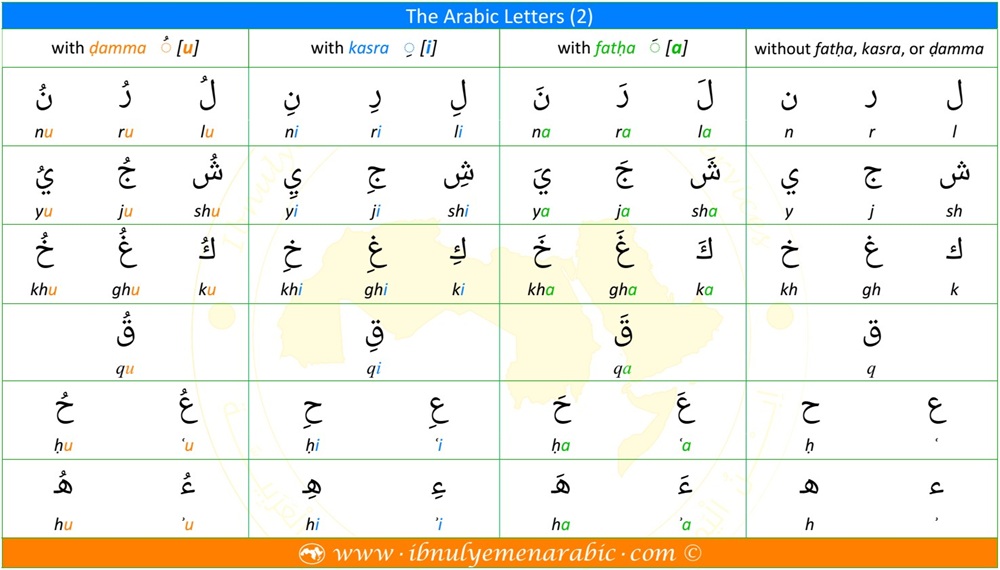
Arabic letters are normally accompanied by the short vowels (al-ḥarakaat ul-qaṣiirah). Note that we don't add these vowels in Modern Standard Arabic (i.e., Arabic that you see in everyday print and websites). However, native speakers of Arabic know which short vowel accompany each letter in a word by intuition. So, each Arabic consonant letter has four different pronunciation depending upon the short vowel that goes with it.
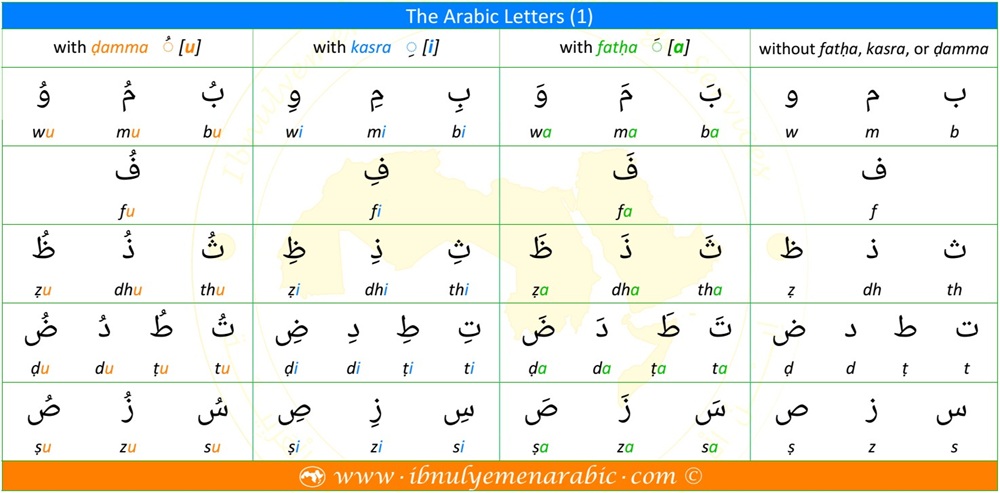
If accompanied by fatḥa [a], we pronounced the letters: ba, ma, wa, fa, tha, etc., as in the second column from the right in table (1) and (2). When accompanied by kasra [i], we pronounce them: bi, mi, wi, fi, thi, etc., as in the third column from the right in table (1) and (2). If a ḍamma goes with the Arabic letters, we pronounced them: bu, mu, wu, fu, thu, etc., as in the fourth column from the right in table (1) and (2). Hence, the pronunciation of Arabic Alif Baa is ba, bi, bu; ta, ti, tu; tha, thi, thu; ja, ji, ju and so on and so forth.
If the Arabic letters are not accompanies by short vowels, they are called saakina (سَاكِنَة). That is, we pronounced them: b, m, w, f, th, etc., as in the first column from the right in table (1) and (2). That is, we pronounce them with a pause, that is without a short vowel. The absence of a short vowel is basically a sukuun (سُكُون - ْ ), which is a diacritical mark. Therefore, Arabic letters have four different pronunciations determined by the accompanying short vowel.
In the next lesson, you will learn how to pronounce the consonant letters with long vowels. We call in long vowels in Arabic al-ḥarakaat ul-ṭaṣiirah (الْحَرَكَاتُ الطَّوِيلَة).