Arabic letters are classified into two categories: the sun letters (الْحُرُوفُ الشَّمْسِيَّة) and the moon letters (الْحُرُوفُ الْقَمَرِيَّة). The Arabic definite article الْـ 'the' triggers this classification. الْـ precedes indefinite nouns and adjectives (i.e., prefixed to them). Basically, the لْـ in الْـ, which is saakin (سَاكِن) or has a sukuun (سُكُون) over it, assimilates to certain subsequent letters. These letters are called the sun letters (also called the solar letters). And it (the لْـ) does not assimilate to the remaining letters. These are called the moon letters (also called the lunar letters).
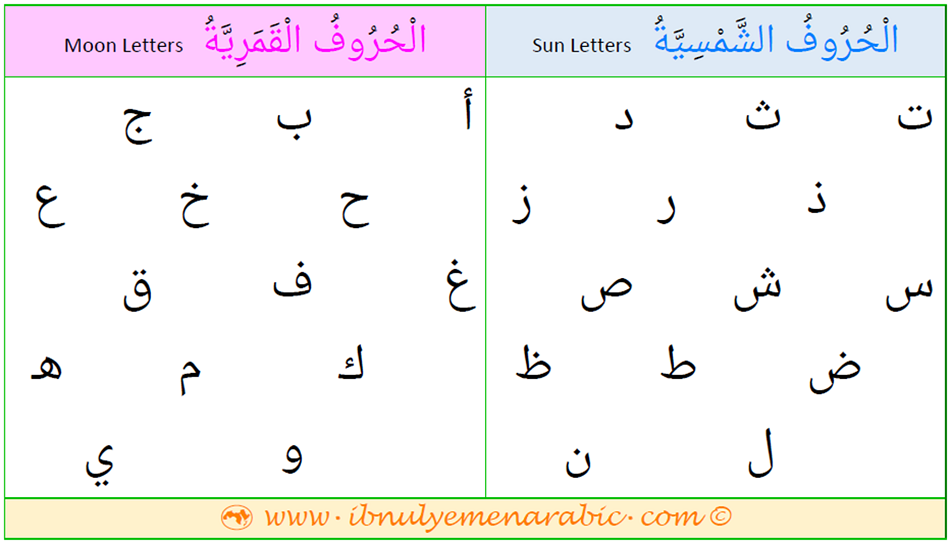
Why does this assimilation happen with the sun letters? Linguistically, it happens because the points of articulation in the oral cavity (the mouth) for the sun letters and that of the لْـ, which is a sun letter, are adjacent. Therefore, the لْـ gets assimilated to the sun letter that follows it. The solar letter, as a result, becomes a geminate (i.e., doubled). This doubling is marked by the shadda ( ّ ) on the sun letter. In phonology (the science of speech sounds), this kind of assimilation occurs because the لْـ and the solar letters share many phonological features. As for writing, the لْـ of the definite article الْـ is not affected; that is, it still is written.
Why are these letters called the solar letters? They are called the sun letters (الْحُرُوفُ الشَّمْسِيَّة) after the word شَمْس "sun", which begins with the letter (sound) ش /sh/ to which the لْـ assimilates. This word (i.e., شَمْس) is chosen because it is one of a kind. Also, it sharply contrasts with the word قَمَر "moon."
If you look at the Arabic diagram of speech sounds presented in a previous lesson, you will notice that the letters that are produced / articulated from the vicinity of the لْـ are:
ت ، ث ، د ، ذ ، ر ، ز ، س ، ش ، ص ، ض ، ط ، ظ ، ل ، ن
In the following table, you can see that the لْـ under the pronunciation column is dropped and replaced with shadda over the subsequent letter (i.e., the sun letter).
الْحُرُوفُ الشَّمْسِيَّة The Sun Letters | ||
نَـكِرَة Indefinite | مَعْرِفَة ( الْـ ) Definite | النُّطْق Pronunciation |
تَدْخِين smoking | التَّدْخِين the smoking | اَتَّدْخِين |
ثَعْلَب a fox | الثَّعْلَب the fox | اَثَّعْلَب |
دَرْس a lesson | الدَّرْس the lesson | اَدَّرْس |
ذِرَاع an arm | الذِّرَاع the arm | اَذِّرَاع |
رَيْحَان basil | الرَّيْحَان the basil | اَرَّيْحَان |
زَبِيب raisins (fruit) | الزَّبِيب the raisins | اَزَّبِيب |
سَبَانِخ spinach | السَّبَانِخ the spinach | اَسَّبَانِخ |
شَارِع a street | الشَّارِع the street | اَشَّارِع |
صُورَة a picture | الصُّورَة the picture | اَصُّورَة |
ضَرِيبَة a tax | الضَّرِيبَة the tax | اَضَّرِيبَة |
طَعَام food | الطَّعَام the food | اَطَّعَام |
ظَلَام darkness | الظَّلَام the darkness | اَظَّلَام |
لَبَن yogurt | اللَّبَن the yogurt | اَلَّبَن |
نِصْف a half | النِّصْف the half | اَنِّصْف |
Why are these letters called lunar letters? The moon letters are named after the word قَمَر "moon" which begins with the letter (sound) ق. The word قَمْر sharply contrasts with the word شَمْس, in addition to being one of a kind. Assimilation of the لْـ of the definite article (الْـ) to the lunar letters is linguistically impossible because their points of articulation is far from that of the لْـ. In other words, they do not share any phonological features with the لْـ. These letters are:
أ ، ب ، ج ، ح ، خ ، ع ، غ ، ف ، ق ، ك ، م ، و ، هـ ، ي
In the table below, you can see that the لْـ of the definite article (الْـ) does not assimilate to the subsequent lunar letter, as shown under the pronunciation column.
الْحُرُوفُ الْقَمَرِيَّة The Moon Letters | ||
نَـكِرَة Indefinite Noun | مَعْرِفَة ( الْـ ) Definite Noun | النُّطْق The Pronunciation |
أَدَب literature | الْـأَدَب the literature | الْأَدَب |
بُرْكَان a volcano | الْبُرْكَان the volcano | الْبُرْكَان |
جَرَس a bell | الْجَرَس the bell | الْجَرَس |
حَرَارَة heat | الْحَرَارَة the heat | الْحَرَارَة |
خُبْز bread | الْخُبْز the bread | الْخُبْز |
عَاصِفَة a storm | الْعَاصِفَة the storm | الْعَاصِفَة |
غَسَّالَة a washing machine | الْغَسَّالَة the washing machine | الْغَسَّالَة |
فُضُول curiosity | الْفُضُول the curiosity | الْفُضُول |
قَامُوس a dictionary | الْقَامُوس the dictionary | الْقَامُوس |
كَلْب a dog | الْكَلْب The dog | الْكَلْب |
مُدَير a manager | الْمُدِير the manager | الْمُدِير |
هَدِيَّة a gift | الْهَدِيَّة the gift | الْهَدِيَّة |
وِسَادَة a pillow | الْوِسَادَة the pillow | الْوِسَادَة |
يَقْطِين pumpkin | الْيَقْطِين the pumpkin | الْيَقْطِين |
Thus, Arabic letters are classified into solar letters and lunar letters. This classification is caused by the لْـ of the definite article (الْـ), a morpheme that is prefixed to indefinite nouns and adjectives to make them definite. This لْـ is always saakin (i.e. has a sukuun over it). The first letter of the word to which it is attached is always vowelized or mutharrik (مُتَحَرِّك); that is, it has a short vowel or haraka (حَرَكَة) over it.
If the vowelized letter to which الْـ is prefixed is one of these ت ، ث ، د ، ذ ، ر ، ز ، س ، ش ، ص ، ض ، ط ، ظ ، ل ، ن, the لْـ is assimilated to it resulting in a doubled sound (a geminate). This doubling is marked by the shadda (شَدَّة) along with the vowel of the letter.